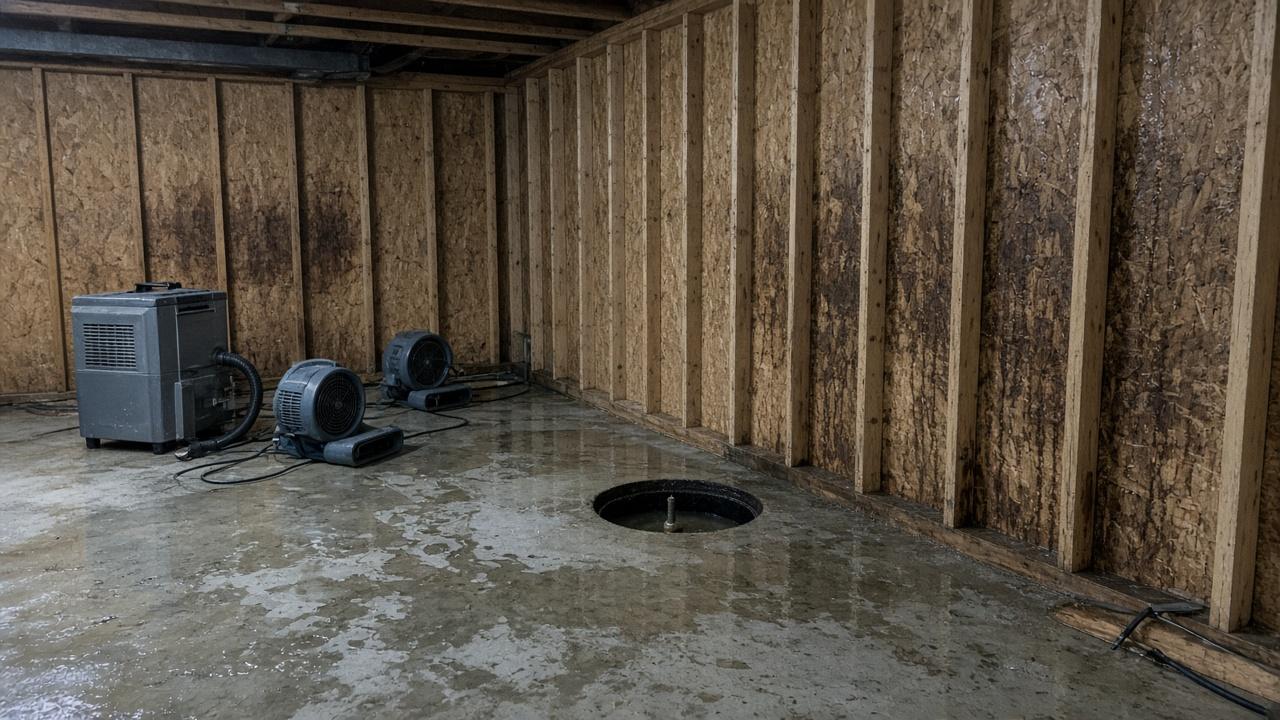
Basement Flooding Restoration Halifax, NS
Basement flooding restoration for Halifax homes: sump pump failures, foundation seepage, and flooded basements cleaned up fast.
Basement Flooding Restoration in Halifax — Foundations Protected, Basements Restored
Basement water damage is the most common water loss Halifax homeowners face. The culprits are predictable: sump pump failures during heavy rain, foundation wall cracks that seep during spring melt, condensation problems from our humid Atlantic air, window wells that overflow, and floor drains that back up when the municipal system gets overwhelmed.
What makes basement water damage particularly serious is the combination of factors that conspire to make it worse: basements are below grade (so water follows gravity in), they tend to be poorly ventilated (so moisture doesn't escape), and they often contain wood framing that's close to the soil (so rot and mold risk are elevated). A basement that floods today and isn't properly dried out in 48–72 hours can become a mold remediation job within a week.
Halifax Water Damage Restoration connects Halifax homeowners with basement water damage specialists who understand these dynamics. Crews carry the equipment to extract standing water from below-grade spaces, the drying tools to reach into crawl spaces and wall assemblies, and the knowledge to identify whether the problem is a one-time event or a symptom of an ongoing water management issue that needs a permanent fix.
Water damage gets worse every hour it sits. Call us and a certified crew will be dispatched to your Halifax property.
902-904-0526Send a MessageCertifications
What Our Basement Flooding Restoration Service Covers
Basement flooding and water intrusion require specialised approaches that differ from above-grade water losses:
Sump Pump Failure Response
When your sump pump fails during a Halifax storm, standing water can accumulate quickly. We extract the water, assess the extent of damage, and help identify whether the pump needs repair or replacement as part of the restoration process.
Foundation Seepage & Crack Repair
Water entering through foundation cracks or through porous concrete blocks is assessed, extracted, and properly dried. Crack injection and waterproofing solutions are discussed as part of preventing recurrence.
Below-Grade Drying
Basements present unique drying challenges — high ambient humidity, limited air circulation, and proximity to soil. Our crews use refrigerant-cycle and desiccant dehumidifiers calibrated for below-grade environments.
Subfloor & Framing Assessment
Below-grade framing — sill plates, rim joists, and stud walls — is assessed for moisture content and rot. Materials that are wet but salvageable are dried in place; compromised structural members are replaced.
Crawl Space Drying
If your Halifax home has a crawl space, water intrusion there requires specialised equipment and approach. Vapour barriers, drainage board, and targeted dehumidification bring crawl spaces to acceptable conditions.
Drain Tile & Sump System Assessment
After a basement flooding event, the underlying drainage system is assessed to determine whether repairs or upgrades will prevent recurrence.
Mold Inspection & Prevention
Basements are the most mold-prone space in a Halifax home. Post-drying inspection and antimicrobial treatment ensure the environment doesn't become a mold breeding ground.
Reconstruction
Drywall, flooring, framing, and finishes in the basement are restored to pre-loss condition once drying is confirmed complete.
Halifax Basement Water Problems — The Real Causes
Halifax sits on a mix of bedrock and glacial till, with significant variation in soil drainage capacity across HRM. Properties in the Sackville River watershed, along Dartmouth's lake-studded terrain, and in the North End near the harbour basin experience higher groundwater pressure during wet seasons. This hydrostatic pressure can push water through poured concrete foundations, through block foundations, and through floor-wall joints that were never designed to resist sustained hydrostatic loading.
Spring melt is a particular risk. Halifax gets enough snowpack most winters that the spring melt — often combined with rain events — saturates the ground before it can drain, sending groundwater levels up sharply and putting pressure on foundations across HRM. Sump pumps that haven't been serviced or tested since the previous season often fail exactly at this moment.
The city's older housing stock compounds the problem. Many Halifax homes built before 1960 have rubble stone foundations, no interior weeping tile, and basement floors poured directly on grade with no vapour barrier. These foundations were designed in an era when basements were unfinished utility spaces that were expected to be damp. Converting them to finished living space means accepting a higher baseline moisture challenge — and a higher consequence when water does get in.
Modern Halifax homes aren't immune either. Even homes built in the last 20 years can experience foundation seepage if the exterior drainage grade has settled, if the weeping tile has collapsed, or if the dampproofing (not to be confused with waterproofing) has deteriorated. A proper basement water damage assessment includes identifying the water pathway — not just drying up what you can see.
How We Handle Basement Water Damage in Halifax
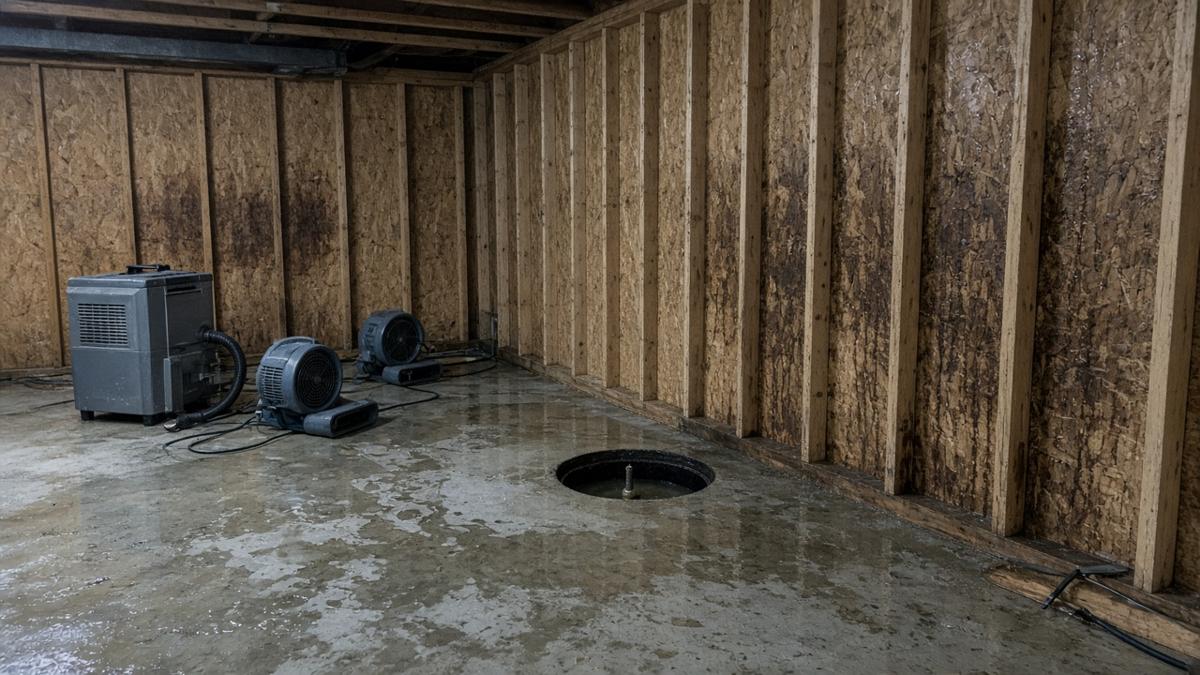
Here's the step-by-step process for a standard Halifax basement flooding restoration job:
- 1
Arrival & Triage
Crew arrives and assesses standing water depth, water source, and category. Power to the basement is confirmed off or safely isolated. Source is confirmed as controlled before extraction begins.
- 2
Water Extraction
Truck-mounted and portable extraction units remove standing water. Submersible pumps handle deep standing water before extractors take over for the final extraction phase.
- 3
Moisture Mapping
Moisture meters and thermal cameras are used to map saturation in walls, floor assemblies, and framing. This creates the baseline for drying monitoring.
- 4
Material Assessment & Demo
Wet drywall, carpet, pad, and insulation are assessed. Non-salvageable materials are removed and disposed of. Framing moisture content is recorded.
- 5
Drying Equipment Placement
Dehumidifiers and air movers are placed following proper drying protocol for below-grade environments. Equipment runs continuously; monitoring visits confirm drying progress.
- 6
Antimicrobial Treatment
All affected structural surfaces receive EPA-registered antimicrobial treatment to prevent mold during the drying period.
- 7
Clearance & Equipment Removal
Final moisture readings confirm target moisture content is achieved throughout the affected assembly. Equipment is removed and a drying report is generated.
- 8
Reconstruction
Insulation, vapour barrier, drywall, flooring, and finishes are restored. Recommendations for preventing future water intrusion are provided at handoff.
Why Halifax Homeowners Call Us for Basement Repairs
Basement water damage is too important to hand to a crew without the right credentials and equipment:
Below-Grade Drying Expertise
Drying a basement requires different equipment and calculations than above-grade spaces. Our crews understand the psychrometrics of below-grade drying in Atlantic Canada's climate.
Mold Prevention First
We don't just dry basements — we treat them to prevent the mold that Halifax's humidity makes almost inevitable if drying isn't done properly.
Honest Assessment of the Source
We tell you where the water came from and what needs to happen to prevent it happening again — not just what it costs to clean up today's damage.
Common Questions About Basement Flooding in Halifax
How do I know if my basement has mold after flooding?
Visual mold growth often appears 1–2 weeks after a water event, but mold can be present in wall cavities, under flooring, and in insulation long before you see it. If your basement has flooded and wasn't professionally dried within 48 hours, a mold assessment is worth doing even if you don't see visible growth.
Can I dry my basement myself with fans and a dehumidifier?
For very minor intrusion — a small area, clean water, caught immediately — consumer equipment can help. For anything involving more than a few square feet, or any basement with framed walls and insulation, professional equipment is necessary. Consumer dehumidifiers don't have the capacity to dry wall assemblies; they're designed for ambient moisture control, not structural drying.
My basement floods every spring. Is there a permanent fix?
Yes, though the right solution depends on the water pathway. Interior drainage systems (drain tile + sump pump) handle hydrostatic pressure and high groundwater. Exterior waterproofing addresses foundation waterproofing failures. Grading and downspout extensions address surface water. A proper basement assessment identifies which approach fits your Halifax property.
How much does basement flooding restoration cost in Halifax?
Cost varies significantly based on the volume of water, the category (clean vs. contaminated), the materials affected, and whether reconstruction is required. Minor losses (small area, caught quickly) can be a few hundred dollars. A fully flooded finished basement with full gut-out and rebuild can be tens of thousands. Insurance often covers sudden and accidental losses; gradual seepage typically isn't covered.
Related Restoration Services
Halifax Water Damage Restoration handles all water-related restoration needs across Halifax and the surrounding region. Return to the homepage for a full overview of what we do.
Ready to Get Your Basement Flooding Started?
Call now and we'll connect you with a certified basement flooding specialist serving Halifax, NS and surrounding areas.