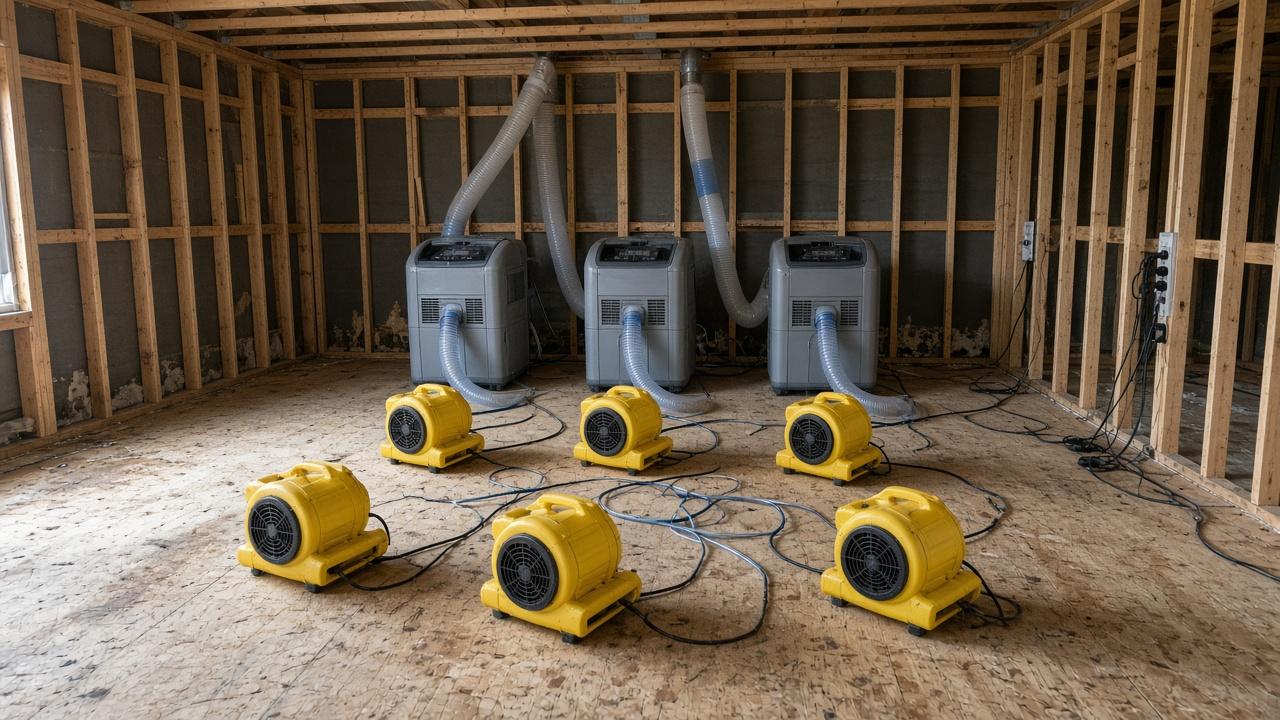
Structural Drying & Dehumidification in Halifax, NS
Scientific structural drying and dehumidification using LGR dehumidifiers and high-velocity air movers calibrated to Nova Scotia's climate.
Structural Drying & Dehumidification in Halifax — Science, Not Guesswork
Structural drying is the phase of water damage restoration that most homeowners don't see — and the one that matters most for the long-term integrity of your home. Extracting standing water is dramatic and immediate. Structural drying is methodical and invisible, but it's the difference between a property that's genuinely dry and one that harbours hidden moisture that drives mold, rot, and ongoing structural problems.
Halifax's Atlantic climate creates specific challenges for structural drying that inland restoration protocols don't address. Our ambient relative humidity — especially in summer and fall — is consistently higher than the target moisture content for structural materials. That means you can't just open windows and run box fans. You need equipment that's calibrated to work against our ambient conditions: LGR (Low-Grain Refrigerant) dehumidifiers that can extract moisture even in high-humidity ambient air, and air movers that create the directed airflow patterns needed to evaporate moisture from inside wall assemblies.
Our IICRC-certified structural drying specialists understand the psychrometrics of water damage restoration — the relationship between temperature, humidity, and drying rate that determines how long equipment needs to run and when it's safe to stop, applied to the specific conditions of Nova Scotia's climate and construction.
Water damage gets worse every hour it sits. Call us and a certified crew will be dispatched to your Halifax property.
902-904-0526Send a MessageCertifications
Structural Drying Services in Halifax
Our Halifax structural drying service is a scientific process with daily monitoring and documented results:
Psychrometric Assessment
Temperature, relative humidity, dew point, and wet-bulb readings throughout the affected area establish the baseline for drying calculations and equipment selection.
LGR Dehumidifier Deployment
Low-Grain Refrigerant dehumidifiers are the workhorse of structural drying. They remove moisture from air even at high ambient humidity — critical in Halifax's climate.
High-Velocity Air Mover Placement
Air movers create directed airflow that accelerates evaporation from structural surfaces. Placement is calculated based on the specific drying plan, not just distributed randomly.
Wall Cavity Drying
Injectidry systems circulate dehumidified air inside wall assemblies without opening walls. Where walls must be opened, drying equipment is directed into the cavity.
Subfloor Drying
Floor systems — OSB, plywood, and hardwood subfloor — require specific drying approaches based on material type and the extent of saturation.
Daily Monitoring & Adjustment
Technicians visit daily to record moisture readings, adjust equipment placement based on drying progress, and update the drying log for your insurance documentation.
Desiccant Dehumidification
For large-scale commercial losses or particularly challenging moisture conditions, desiccant dehumidifiers supplement LGR systems to accelerate drying.
Clearance Documentation
Final moisture readings — taken at multiple points throughout the affected assembly — confirm all materials are within IICRC target moisture content. This is the document that closes the drying phase and opens the reconstruction phase.
Why Halifax's Climate Makes Structural Drying Harder
Halifax sits in a humid continental climate zone with strong maritime influence. Our average annual relative humidity runs above 70%, with regular periods — particularly summer fog events and late fall rain periods — where ambient humidity reaches 85–95%. These conditions actively work against structural drying. Evaporation from wet materials only occurs when the air in contact with the surface is below saturation. When ambient air is at 85% relative humidity, you're fighting the climate.
This is why LGR dehumidifiers matter specifically for Halifax. A standard refrigerant dehumidifier loses efficiency at high ambient relative humidity and low temperatures — exactly the conditions we have during fall and winter water damage events. LGR dehumidifiers maintain efficiency at lower grain levels, which means they continue to extract moisture effectively even when conditions are challenging.
The wood-frame construction common in Halifax housing also presents specific drying challenges. Wood moisture content varies by species, thickness, and orientation. Kiln-dried framing lumber has a moisture content around 15–19% when it leaves the mill. After a water loss, that same framing can reach 35–50% or higher. The target for structural wood is below 16% moisture content — any higher and conditions are favourable for mold growth and wood decay. Getting from 40% to 16% in Atlantic humidity requires the right equipment and patience.
Drying documents matter for insurance and real estate. A drying log that records daily moisture readings throughout the affected assembly gives your insurance adjuster documented proof that the drying was done properly and that equipment ran for the period required to achieve target moisture content. When it comes time to sell your Halifax home, a documented restoration that includes clearance readings is worth far more than a property where 'it got wet once and we dried it out.'
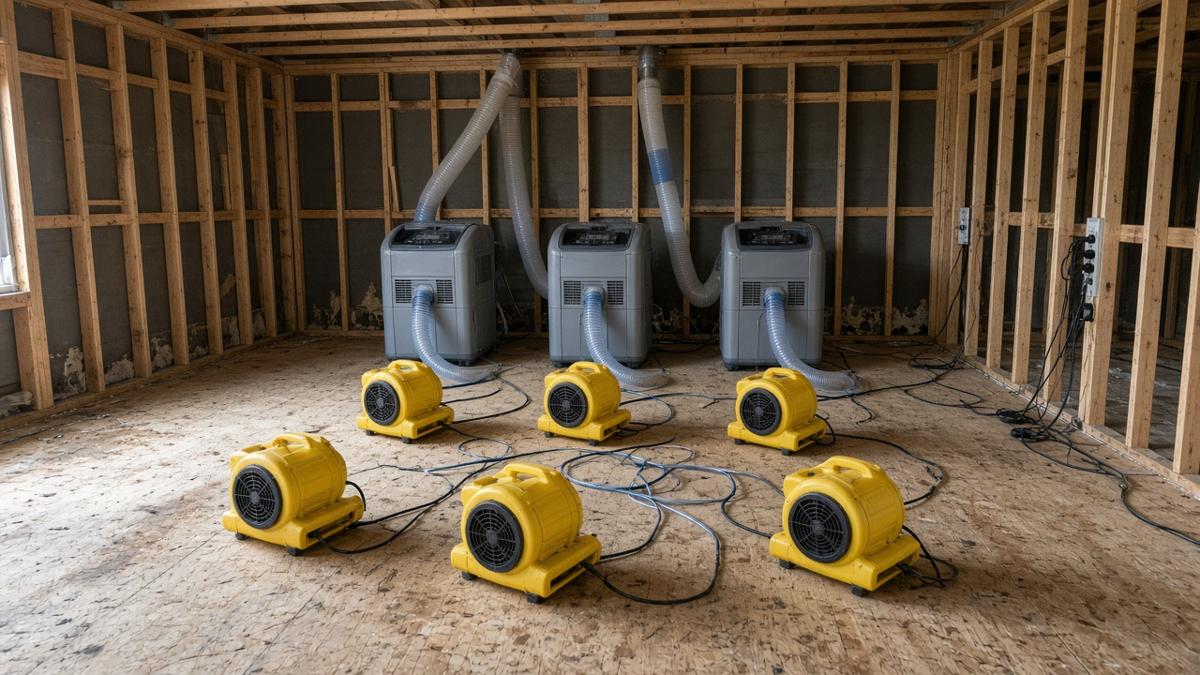
Structural Drying Process in Halifax
Here's how a structural drying engagement proceeds from equipment placement to clearance:
- 1
Initial Psychrometric Reading
Ambient temperature, relative humidity, and specific humidity are measured throughout the affected area. Structural materials are measured with pin and pinless moisture meters at multiple points.
- 2
Equipment Calculation
The number and placement of dehumidifiers and air movers is determined based on the volume of wet materials and ambient conditions, not by default.
- 3
Equipment Placement
Dehumidifiers and air movers are placed per the calculated drying plan. Air movers create a vortex drying pattern; dehumidifiers process the moisture-laden air they produce.
- 4
Day 1 Follow-Up
24 hours after placement, moisture readings are taken throughout the assembly and compared to baseline. Equipment is adjusted if the drying curve isn't tracking as expected.
- 5
Daily Monitoring
Moisture readings and psychrometric data are recorded daily in the drying log. Each day's readings tell the story of whether the drying is progressing as expected.
- 6
Equipment Adjustment
As drying progresses, equipment may be adjusted — relocated to focus drying power on areas that are drying more slowly, or reduced as areas reach target moisture content.
- 7
Clearance Testing
When readings indicate target moisture content is achieved throughout the assembly, clearance readings are taken at all monitoring points and documented in the final drying report.
- 8
Equipment Removal
Equipment is removed and the space is returned to you. Final drying report is provided — including all daily moisture readings from start to clearance.
Why Structural Drying Requires Scientific Expertise
Setting up a few fans isn't structural drying. Here's what our Halifax network brings:
Climate-Calibrated Equipment
LGR dehumidifiers that maintain efficiency in Halifax's humid Atlantic air — not standard dehumidifiers that lose performance exactly when you need them most.
Calculated Equipment Placement
Equipment placement and quantity based on actual drying science, not guesswork. The right gear in the right place runs for the right amount of time.
Daily Documentation
Moisture logs from day one through clearance — the evidence your insurance company needs and the record that protects your property's value.
Common Questions About Structural Drying in Halifax
How long does structural drying take in Halifax?
Typical residential structural drying takes 3–5 days for a Class 2 loss (water affecting wall assemblies in one room) and 5–7 days for more extensive losses. Concrete, hardwood flooring, and thick lumber take longer than drywall and softwood framing. Daily monitoring confirms when target moisture content is achieved — we don't just run equipment for a set number of days.
Can walls be dried without opening them?
Often yes, using Injectidry wall cavity systems. Small holes are drilled (which are easily patched) to allow dehumidified air to circulate inside the wall. Whether this approach is appropriate depends on the volume of water in the cavity, the material type, and how long the materials have been wet.
How do I know when structural drying is complete?
Structural drying is complete when moisture readings in all affected materials are below the IICRC-standard target moisture content — typically 16% or below for wood framing, and the appropriate EMC (Equilibrium Moisture Content) for other materials. This is confirmed by calibrated readings, not by how the space looks or feels.
Related Restoration Services
Halifax Water Damage Restoration handles all water-related restoration needs across Halifax and the surrounding region. Return to the homepage for a full overview of what we do.
Ready to Get Your Structural Drying Started?
Call now and we'll connect you with a certified structural drying specialist serving Halifax, NS and surrounding areas.